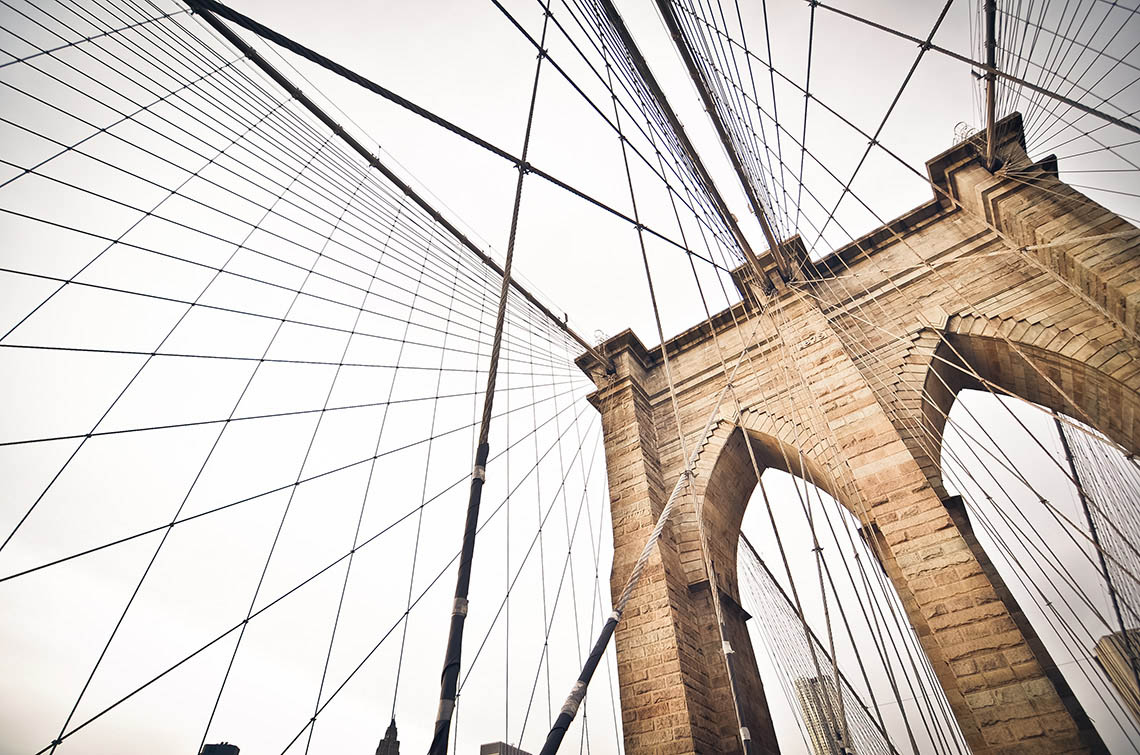
Brooklyn, New York
Formerly standing in the shadow of its brother Manhattan, Brooklyn is now bouncing back in a spectacular way.
Brooklyn is geographically adjacent to the borough of Queens at the western end of Long Island. Since 1896, Brooklyn has had the same boundaries as Kings County, the most populous county in the State of New York and the second-most densely populated county in the United States, after New York County (Manhattan).
In the first decades of the 21st century, Brooklyn has experienced a renaissance as an avant-garde destination for hipsters, with concomitant gentrification, dramatic house price increases, and a decrease in housing affordability. Since 2010 it has evolved into a thriving hub of entrepreneurship and high technology startup firms, and of postmodern art and design.
History
The history of European settlement in Brooklyn spans more than 350 years. The settlement began in the 17th century as the small Dutch-founded town of "Breuckelen" on the East River shore of Long Island, grew to be a sizable city in the 19th century, and was consolidated in 1898 with New York City (then confined to Manhattan and part of the Bronx), the remaining rural areas of Kings County, and the largely rural areas of Queens and Staten Island, to form the modern City of New York. Many Brooklyn neighborhoods are ethnic enclaves where particular ethnic and nationality groups and cultures predominate.
Colonial Era
In the Colonial era, The Dutch were the first Europeans to settle Long Island's western edge, which was then largely inhabited by the Lenape, a Native American. The "Breuckelen" settlement, named after Breukelen in the Netherlands, was part of New Netherland. After the final English conquest of New Netherland in 1664, New Netherland was taken in a naval action, and the conquerors renamed their prize in honor of the overall English naval commander, James, Duke of York.
Post-Colonial era
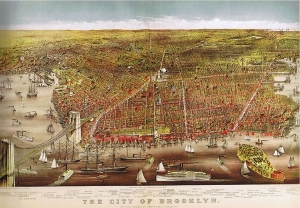
In 1883, the Brooklyn Bridge was completed, transportation to Manhattan was no longer by water only, and the City of Brooklyn's ties to the City of New York were strengthened. The first half of the 19th century saw the beginning of the development of urban areas on the economically strategic East River shore of Kings County, facing the adolescent City of New York confined to Manhattan Island. The New York Navy Yard operated in Wallabout Bay (border between Brooklyn and Williamsburgh) for the entire 19th century and two-thirds of the 20th century
Two major institutions were created in the 1860s. First The Brooklyn Eagle, and Kings County Democrat published by Alfred G. Stevens. It later became the most popular and highest circulation afternoon paper in America. Second the borough's soon-to-be-famous National League baseball team, the Brooklyn Dodgers. But both major institutions were lost in the 1950s: the paper closed in 1955 after unsuccessful attempts at a sale following a reporters' strike, and the baseball team decamped for Los Angeles in a realignment of major league baseball in 1957.
Since the late 20th century, Brooklyn has benefited from a steady influx of financial back office operations from Manhattan, the rapid growth of a high-tech and entertainment economy in DUMBO, and strong growth in support services such as accounting, personnel supply agencies, and computer services firms.
Things to do
Architecture
Brooklyn Bridge is a hybrid cable-stayed/suspension bridge in New York City and is one of the oldest bridges of either type in the United States. Completed in 1883, it connects the boroughs of Manhattan and Brooklyn by spanning the East River. Since its opening, it has become an icon of New York City and was designated a National Historic Landmark in 1964 and a National Historic Civil Engineering Landmark in 1972. This is one of the must-see places in New York City and is often featured in wide shots of the New York City skyline in television and film.
Brooklyn Navy Yard was listed on the National Register of Historic Places as a historic district, and certain buildings have also been given landmark status. Quarters A, the commander's quarters building, The Navy Yard Hospital Building, and Surgeon's Residence.
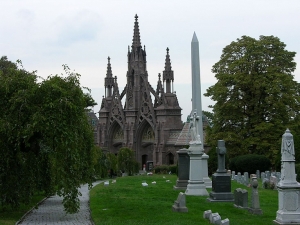
Green-Wood Cemetery was founded in 1838 as a rural cemetery in Kings County, New York. The cemetery lies several blocks southwest of Prospect Park, between Park Slope, Windsor Terrace, Borough Park, Kensington, and Sunset Park. Paul Goldberger in The New York Times wrote that it was said "it is the ambition of the New Yorker to live upon the Fifth Avenue, to take his airings in the Park, and to sleep with his fathers in Green-Wood". The cemetery was listed on the National Register of Historic Places in 1997 and was granted National Historic Landmark status in 2006.
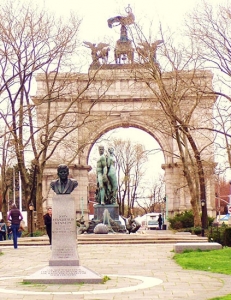
Grand Army Plaza is a public plaza that comprises the northern corner and the main entrance of Prospect Park. The plaza includes the Soldiers' and Sailors' Arch, the Bailey Fountain, the John F. Kennedy Monument, statues of Civil War generals Gouverneur K. Warren and Henry Warner Slocum, busts of notable Brooklyn citizens Alexander J.C. Skene and Henry W. Maxwell, and two 12-sided gazebos with "granite Tuscan columns, Guastavino vaulting, and bronze finials".
Parks and Recreation
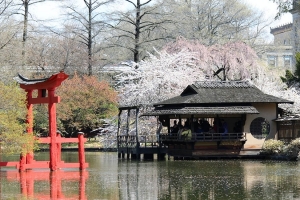
Brooklyn Botanic Garden located adjacent to Prospect Park is the 52-acre (21 ha) botanical garden, which includes a cherry tree esplanade, a one-acre (0.4 ha) rose garden, a Japanese hill and pond garden, a fragrance garden, a water lily pond esplanade, several conservatories, a rock garden, a native flora garden, a bonsai tree collection, and children's gardens and discovery exhibits.
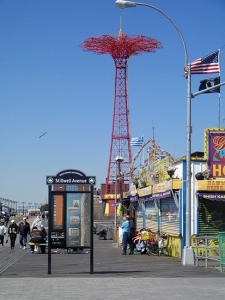
Coney Island developed as a playground for the rich in the early 1900s, but it grew as one of America's first amusement grounds and attracted crowds from all over New York. The Cyclone rollercoaster, built in 1927, is on the National Register of Historic Places.
New York Transit Museum displays historical artifacts of Greater New York's subway, commuter rail, and bus systems; it is located at Court Street, a former Independent Subway System station in Brooklyn Heights on the Fulton Street Line.
Jamaica Bay Wildlife Refuge is a wildlife refuge in New York City managed by the National Park Service as part of Gateway National Recreation Area. It is composed of the open water and intertidal salt marshes of Jamaica Bay. The refuge provides habitat for a wide variety of flora and fauna, both marine and terrestrial. It is a prime location for viewing birds and bird migrations, diamondback terrapin egg-laying and horseshoe crab mating and egg laying.
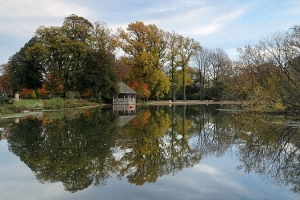
Prospect Park was designed by Frederick Law Olmsted and Calvert Vaux after their completion of Manhattan's Central Park. Main attractions of the park include the 90-acre Long Meadow; the Picnic House; Litchfield Villa, Prospect Park Zoo; The Boathouse, Brooklyn's only lake, covering 60 acres; the Prospect Park Bandshell that hosts free outdoor concerts in the summertime. The park also has sports facilities including seven baseball fields in the Long Meadow, and the Prospect Park Tennis Center, basketball courts, baseball fields, soccer fields, and the New York Pétanque Club in the Parade Ground.
Culture
Brooklyn has played a major role in various aspects of American culture including literature, cinema, and theater. Brooklyn is home to the world-renowned Brooklyn Academy of Music, the Brooklyn Philharmonic, and the second largest public art collection in the United States, housed in the Brooklyn Museum.